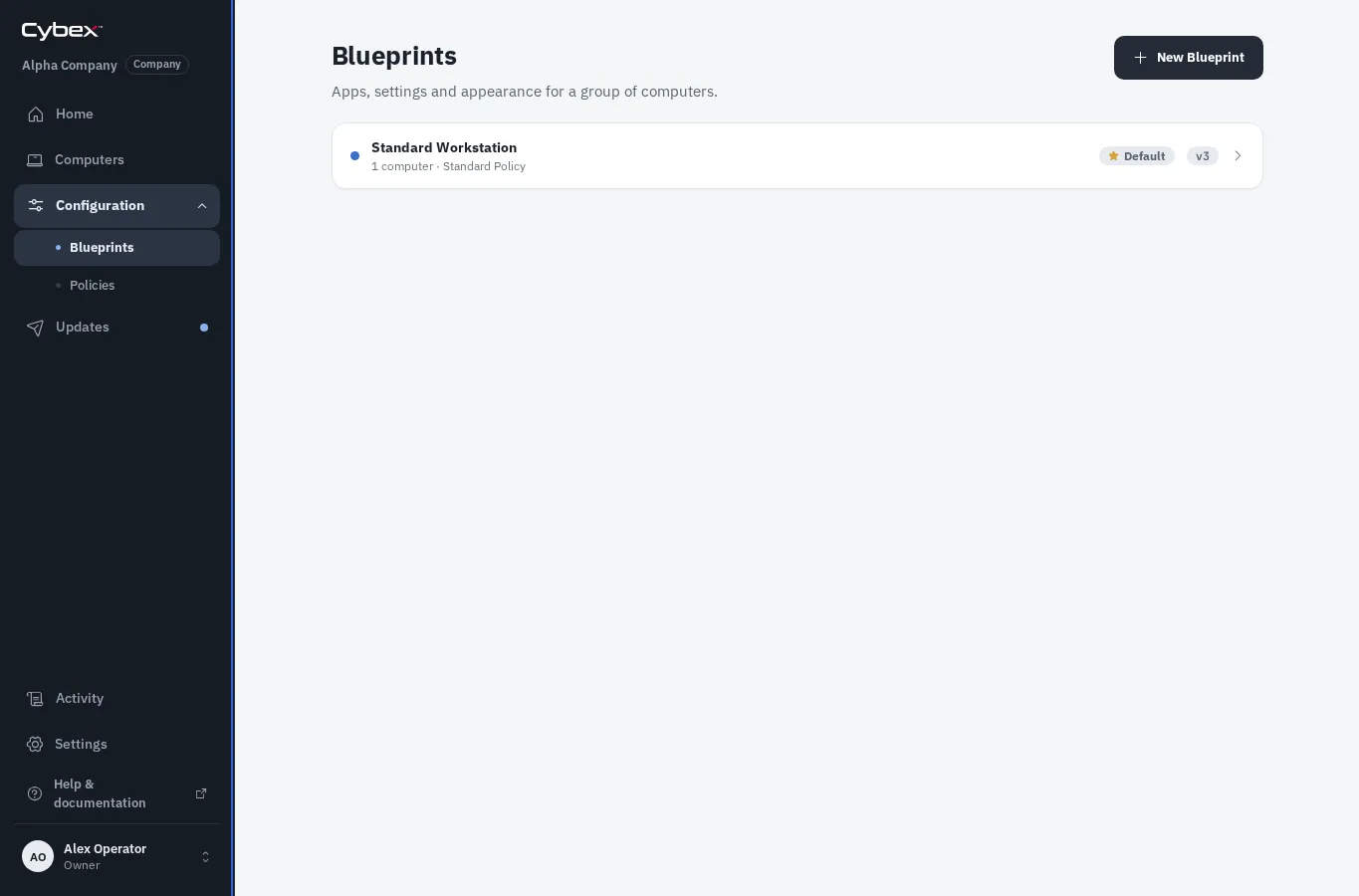

Create and edit Blueprints
A Blueprint is the desired workstation experience for one or more computers. It owns the choice of App Lists, Desktop Experience, appearance, kiosk behavior, and assignment. Its assigned Policy separately owns organization rules such as sign-in, security, networking, access, and updates.

Create a Blueprint
Section titled “Create a Blueprint”- Open Configuration > Blueprints and select New Blueprint.
- Start from the base configuration, duplicate an existing Blueprint, or capture supported settings from a computer.
- Give it a purpose-based name, such as “Library kiosk” or “Staff workstation.”
- Confirm the automatically attached Default Policy. Change Policy assignment later under Advanced settings > Assignment only when this Blueprint needs a different organization rule set.
- Review the new Blueprint before assigning computers.
Import from a reference computer
Section titled “Import from a reference computer”Use a managed reference computer when you want a Blueprint to start from a desktop you have already adjusted:
- Deploy the Blueprint to the reference computer and sign in with a wheel administrator account. Set Appearance enforcement to Defaults only before deploying when you want to keep changing its wallpaper or theme in the desktop settings app.
- Adjust the supported desktop settings, theme, wallpaper, default applications, and installed applications on that computer.
- In the Blueprint’s Management menu, choose the computer import action and start the scan. Keep the computer online until the review appears.
- Review the comparison line, supported components, and Not imported groups. A managed computer is compared with the exact Blueprint version it was running, so inherited values are not mistaken for your changes.
- Create the Blueprint or update the existing one, review the resulting prepared version, select Release, and then use Deploy to try it on a test computer before a wider rollout.

You can repeat the import after every adjustment. Resetting a desktop setting on the reference computer removes that captured default on the next import; a Console-authored value remains enforced and is never overwritten. An unmanaged computer has no comparison baseline, so its recognized applications are added but existing App List entries are never removed.
Edit a Blueprint
Section titled “Edit a Blueprint”- Open the Blueprint and change its App Lists, Desktop Experience, appearance, kiosk behavior, or assignment. Apps themselves are edited on the App List; every Blueprint that uses the list follows.
- Follow the Policy link when you need to change sign-in, security, networking, access, update, printing, or monitoring rules. Those settings cannot be authored in a Blueprint.
- Expand Advanced settings only when the task needs a less common Blueprint-owned experience setting. Open one category at a time.
- Select Save draft when you want to keep editing later. A draft never changes a version or a computer.
- Select Prepare release to freeze the draft as an immutable version. When your organization uses James, Cybex prepares that exact version before it can be released.
- Select Release after reviewing compatibility. Releasing makes the version selectable but does not change any computer.
- Select Deploy to update assigned computers, using one test computer first when appropriate.
Rename, delete, capture, revision details, and other infrequent controls are grouped under Management. Prefer small, reviewable changes over unrelated changes bundled into one release.
Desktop settings
Section titled “Desktop settings”Beneath the Desktop Experience choice, the desktop settings row shows how many settings you have customized for that desktop. Select Configure… to open them.
- Only the settings the selected desktop supports are shown: Taskbar (window behavior, workspace behavior, session), Dock and other GNOME experiences (appearance, windows, input, clock, notifications, sound, power, privacy, accessibility), Tiling (layout, decoration, animations, input), and a small subset for Kiosk.
- Every control names its default. A value imported from a reference computer is marked From computer. A control you changed in the Console is marked Customized and takes priority; Reset removes your Console choice so the imported value (or the managed default) applies again. Reset all does that for every Console-authored control.
- Apply to draft stores the choices in the Blueprint draft; nothing reaches a computer until you save and release the Blueprint. Changes take effect from the next sign-in on updated computers.
- Settings for a desktop you are not using right now are kept. If you switch from Taskbar to Dock and back, your Taskbar choices apply again.
- A value marked Custom value cannot be represented by the choices in this dialog. Ask an operator to inspect or remove the corresponding authored or captured blob in the Operator workspace.
The Appearance enforcement choice controls wallpaper, theme, icons, cursor, and fonts. Enforced keeps those Blueprint choices fixed. Defaults only supplies them as the starting appearance but lets each person change them on their computer. Security settings remain enforced in both modes. Theme chooses a tested pack across GNOME, KDE Plasma, and tiling desktops; a captured wallpaper is normalized into the organization’s wallpaper library rather than copied into a home directory.
Desktop apps
Section titled “Desktop apps”Each Desktop Experience installs a set of apps on its own — GNOME ships Music, Maps, Weather, and Contacts, KDE Plasma ships Elisa and Gwenview, and so on. Beneath the Desktop Experience choice, the Desktop apps row shows what the selected desktop ships and lets you decide which of them stay:
- Keep all leaves the desktop’s own apps untouched (the default).
- Essentials keeps the everyday tools (file viewer, calculator, document viewer) and removes the rest.
- None removes every app the desktop would add on its own.
- Choose… lets you tick the exact apps to keep.
Files, System Settings, the terminal, and the Cybex Agent are never removed here; whether computers get a terminal is decided by the Policy’s Terminal access restriction. Applying a curated set needs computers on a workstation runtime that supports it; the Deploy page shows that requirement in the plan and updates the runtime first. Apps you add yourself come from App Lists.
Default Blueprint
Section titled “Default Blueprint”Marking a Blueprint as the default preselects it for newly adopted computers. It does not silently reassign existing computers.